Dakota Gasification Company
Headquarters:
1717 East Interstate Avenue | Bismarck, ND 58503-0564 USA
701.223.0441 | 1.800.242.2372
Great Plains Synfuels Plant
420 County Road 26
Beulah, ND 58523-9400 USA
701-873-2100
A subsidiary of:

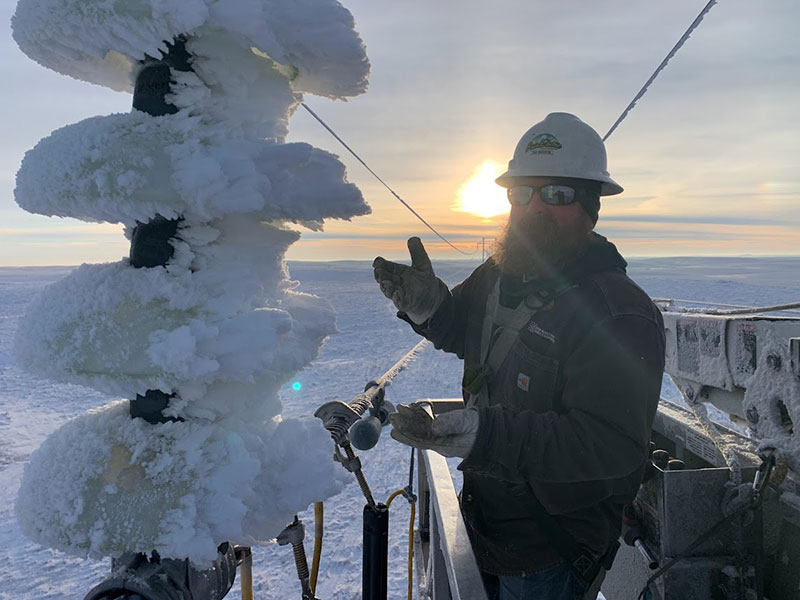
When a fault occurs on a high-voltage transmission line, the first priority for the Transmission Systems Maintenance (TSM) team is simple: find it quickly. Transmission lines can stretch for hundreds of miles, often across remote terrain, so locating the exact problem area is critical for restoring service and maintaining reliability. One of the most accurate tools TSM uses to do this is called traveling wave fault location.
A traveling wave is a method used to pinpoint faults on transmission lines by measuring how fast electrical disturbances move along the line. To understand why this matters, imagine a long transmission line like the Antelope Valley Station–Broadland line, which spans roughly 300 miles. “If something disrupts that line such as a failed structure during an ice storm, or something as simple as bird droppings, technicians need to determine where along those 300 miles the event occurred,” Stephen Farnsworth, system protection superintendent, says. “Without accurate information, crews may have to inspect dozens of miles of line before finding the issue.”
For many years, Basin Electric used the impedance method to locate faults on transmission lines. “In simple terms, this method estimates where a fault happened by measuring the electrical impedance along the line,” Farnsworth says. “When engineers design and build a transmission line, they calculate its electrical characteristics and use that information to set up protective relays. These relays are devices that constantly monitor the line and quickly detect abnormal electrical conditions, such as faults.”
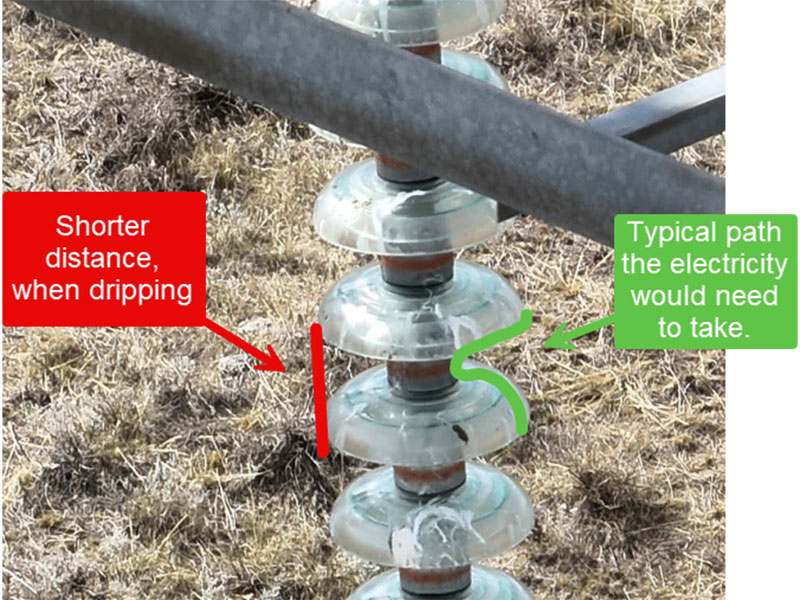
While this approach works well in theory, real-world conditions can make it less precise. The resistance of a transmission line changes as the conductor heats up or cools down. Nearby transmission lines can influence electrical measurements as well. Even the type of fault itself, for example, ice accumulation causing a flashover, can affect how the relay interprets resistance. Because of these variables, the impedance method can sometimes produce errors of five to ten percent.
“On a 300-mile line, that error could translate to as much as 30 miles of uncertainty,” Farnsworth says. “For line crews, that could mean inspecting dozens of transmission structures, climbing towers, and patrolling large areas before finding the actual problem. Clearly, a more precise method would save time and effort.”
That’s where traveling wave technology comes in.
Instead of relying on impedance, traveling wave fault location measures time. When a fault occurs, it creates a sudden electrical disturbance, or a wave, that travels along the transmission line at nearly the speed of light. Because utilities know the physical length of their transmission lines and the approximate speed at which electrical signals travel along them, they can calculate the location of a fault by measuring how long it takes that wave to reach protective relays at each end of the line.
Because this method relies on timing rather than impedance, it is not affected by temperature changes, nearby transmission lines, or other conditions that influence electrical measurements. “Traveling wave technology can narrow a fault location to within about 1,000 feet, which is roughly the distance between two transmission structures,” Farnsworth says. “Instead of searching dozens of miles, crews can focus on a very small section of line.”
Although the concept of traveling waves has existed since the 1980s, the technology has become far more practical in recent years. “Basin Electric has used traveling wave technology since around 2014, and since 2023 the cooperative has made a strong push to expand its use across the system, particularly on longer transmission lines and on new construction where compatible relays are installed,” Farnsworth says.
For TSM, the benefits are clear. Faster and more precise fault location means crews spend less time searching and more time repairing, which leads to quicker restoration of service for members who depend on Basin Electric to provide them with safe and reliable electricity every day.
Dakota Gasification Company
Headquarters:
1717 East Interstate Avenue | Bismarck, ND 58503-0564 USA
701.223.0441 | 1.800.242.2372
Great Plains Synfuels Plant
420 County Road 26
Beulah, ND 58523-9400 USA
701-873-2100
A subsidiary of:
Basin Electric wants all interested and qualified candidates to apply for employment opportunities. If you are an applicant with a disability who is unable to use our online tools to search and apply for jobs, or who needs other assistance or accommodations, please contact us at 701-223-0441. Please indicate the specifics of the assistance needed or provide your contact information, and a Basin Electric Human Resources representative will contact you. Basin Electric is an Equal Employment Opportunity Employer regarding race, color, religion, sex, sexual orientation, gender identity, national origin, disability, and veterans status.