
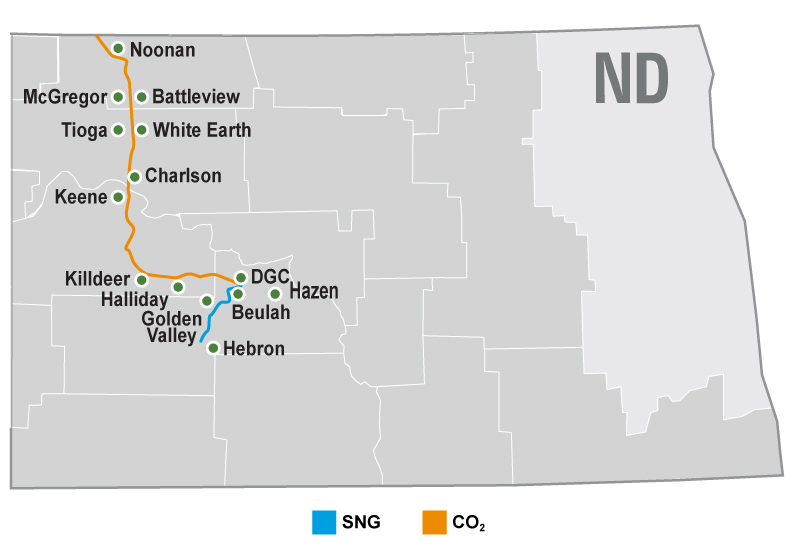
The Great Plains Synfuels Plant owns and operates one carbon dioxide pipeline and operates another carbon dioxide pipeline.
The operated carbon dioxide pipeline transports carbon dioxide captured at the plant and transports it to oil fields in Canada. The owned and operated pipeline is part of the Great Plains Sequestration Project.
Great Plains CO2 Sequestration Project
Basin Electric and Dakota Gas continue to be an industry leader on carbon capture utilization and storage solutions. In 2024, the Great Plains Synfuels Plant became home to one of the largest geologic CO2 sequestration projects in the world.
The Great Plains CO2 Sequestration Project went into service in mid-February 2024, and it’s expected the facility will capture up to 2.25 million metric tons of CO2 per year. The 6.8-mile pipeline crosses reclaimed mine land and other utility development that is owned by Basin Electric and The Coteau Properties Company, which operates the Freedom Mine.
The pipeline carries captured CO2 from the Great Plains Synfuels Plant to a permanent geologic storage reservoir adjacent to the facility, the Broom Creek sandstone formation. Broom Creek was deemed an ideal storage location because of its superior reservoir quality, depth, impermeable upper and lower confining zones, and expansive areal extent. Preliminary estimates suggest a maximum Broom Creek storage capacity exceeding 10 billion metric tons of CO2.
The Great Plains CO2 Sequestration Project is operating safely, and each individual well is performing better than the original modeling, which provides a favorable outlook for long-term economic return on investment.
Carbon dioxide pipeline
Dakota Gas operates a pipeline that delivers CO2 produced at the plant to customers and transports it through a 205-mile pipeline to Saskatchewan, Canada, to be used for enhanced oil recovery in the Weyburn field.
The first CO2 was sent to Canada in October 2000. Today, Dakota Gas exports up to 155 million cubic feet per day of CO2 to Canada - about two-thirds of the readily available CO2 when running at full rates.